
Sanjay Kumar Garg, Director, Aryav Eco-friendly Resources Pvt Ltd
Water has always been the foundation of civilization. From ancient river valleys to modern megacities, access to clean drinking water has shaped economies, health outcomes and human dignity. Yet, in the 21st century, water scarcity has emerged as one of the most pressing global challenges—ironically at a time when technology has reached unprecedented heights. While rivers are drying, groundwater tables are falling, and municipal systems are under immense stress, one abundant source of water remains largely underutilized: the atmosphere. Every day, trillions of liters of fresh water exist invisibly around us in the form of humidity. The question is no longer whether water exists, but how intelligently we can access it.This is where Atmospheric Water Generators (AWGs) step in—transforming humidity into humanity’s most essential resource.
The Global Water Crisis: A Reality Check
According to global estimates, nearly two billion people lack access to safely managed drinking water. Rapid urbanization, climate change, industrial demand, and over-extraction of groundwater have pushed traditional water sources beyond their sustainable limits.
In many regions:
- Borewells are running dry or yielding contaminated water
- Rivers are polluted by industrial and domestic waste
- Desalination, while effective, remains energy-intensive and expensive
- Water transportation is logistically complex and carbon-heavy
Ironically, even water-stressed regions often experience moderate to high atmospheric humidity for significant parts of the year. The atmosphere, therefore, represents a decentralized, renewable, and borderless water source— available everywhere, every day.
The Science Behind the Sky’s Reservoir
The Earth’s atmosphere holds an astonishing 12,900 cubic kilometers of water at any given moment—equivalent to roughly 10% of all freshwater in lakes worldwide. This vast aerial reservoir constantly cycles through evaporation and precipitation, creating an ever-present source of water that, until recently, remained largely untapped for human consumption.
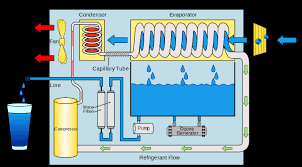
Atmospheric Water Generators harness this resource through several technological approaches, each drawing upon fundamental principles of thermodynamics and condensation. The most common method employs a cooling condensation process similar to how a cold glass collects water droplets on a humid day. Air is drawn into the device where it encounters refrigerated coils cooled below the dew point—the temperature at which water vapor condenses into liquid form. As the air cools, moisture condenses on these surfaces, drips into collection reservoirs, and undergoes filtration and purification before becoming potable water.
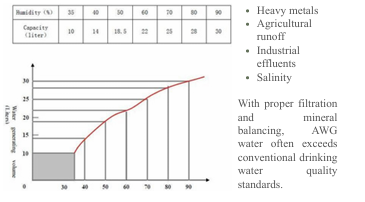
Alternative technologies include desiccant-based systems that use moisture absorbing materials to capture water vapor, subsequently releasing it through heating processes, and advanced solid-state systems utilizing materials like metal-organic frameworks that can capture water molecules with remarkable efficiency. Some cutting-edge designs even employ Peltier cooling elements or incorporate renewable energy sources like solar panels, making them viable for off-grid applications in remote areas. The efficiency of these systems depends heavily on environmental conditions. Humidity levels, temperature, and atmospheric pressure all play crucial roles in determining water production rates. Most AWGs operate optimally in environments with relative humidity above 30%, though advanced models can function in drier conditions. A typical residential unit might produce 20-30 liters of water daily under favorable conditions, while industrial-scale systems can generate thousands of liters.
Understanding Atmospheric Water
Air is not empty. It carries water vapor in varying quantities depending on temperature and relative humidity. Warmer air holds more moisture, and as air cools, it releases this moisture in the form of condensation—just like dew forming on grass in the early morning. Nature has used this principle for millions of years. Humans are now replicating it using engineering and thermodynamics. Atmospheric Water Generators capture moisture from ambient air, condense it into liquid water, purify it, and make it suitable for drinking or utility use.
What is an Atmospheric Water Generator (AWG)?
An Atmospheric Water Generator is a machine that:
1.Draws in ambient air
2.Cools it below its dew point to condense water vapor
3.Collects the condensed water
4.Filters and mineralizes it
5.Delivers clean, potable water on demand
In simple terms, AWGs turn air into water—without depending on groundwater, surface water, or municipal pipelines.
Core Technology Behind AWGs
1. Air Intake and Filtration: Ambient air is drawn through multi-stage
filters that remove dust, pollen, and pollutants.
2. Condensation System: Using refrigeration or advanced heat-exchange
systems, the air is cooled until water vapor condenses into liquid droplets.
3. Water Collection: The condensed water is collected in food-grade storage
Tanks.
4. Purification and Mineralization: UV sterilization, carbon filtration &
mineral dosing ensure the water is safe, palatable & compliant with drinking
water standards.
5. Intelligent Controls: Modern AWGs are equipped with sensors &
controllers to optimize production based on humidity, temperature & energy
availability.
Why Atmospheric Water Is the Purest Source
Atmospheric water is naturally distilled. Unlike groundwater or surface water, it does not carry:
AWGs vs Conventional Water Sources
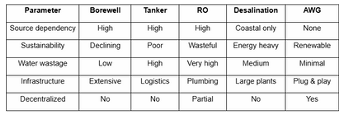
AWGs stand out as infrastructure-light, decentralized & future-ready solutions.
Energy and Sustainability Considerations
Critics often ask: Is atmospheric water energy-intensive?
The answer depends on design efficiency, operating conditions, and energy
source. Modern AWGs:
- Operate optimally in moderate to high humidity
- Use energy-efficient compressors and heat recovery
- Can be powered by solar or hybrid energy systems
- Eliminate the hidden energy cost of pumping and transporting water
When evaluated holistically, AWGs often have a lower lifecycle environmental footprint than tanker water or deep borewell extraction.
Atmospheric Water and Climate Resilience
Climate change is making rainfall patterns unpredictable. Floods & droughts are becoming two sides of the same coin. AWGs introduce climate resilience by:
- Decoupling water supply from rainfall
- Reducing stress on aquifers
- Offering modular scalability
- In a future where water uncertainty is the norm, adaptive technologies like
- AWGs will define survival and growth.
The Indian Context: A Perfect Fit
India faces a unique water paradox:
- High population density
- Rapid urbanization
- Severe groundwater depletion
- High humidity across large geographies
From coastal cities to inland urban centers, AWGs align naturally with India’s climate and sustainability goals. Government focus on:
- Water self-reliance
- Net-zero targets
- Smart cities
- Green buildings
makes atmospheric water an idea whose time has come.
Net Zero Water Concept
Net zero water means balancing consumption with on-site generation, achieving no net draw from external supplies. AWGs enable this by harvesting atmospheric vapor—renewable & infinite—offsetting usage through condensation rather than extraction. In closed-loop systems, condensate recycles internally, minimizing waste. For buildings or campuses, pairing AWGs with rainwater storage hits net zero, as seen in green-certified structures.
Sustainable Advantages
AWGs slash reliance on municipal grids or aquifers, cutting embodied water in supply chains. Solar-powered variants achieve carbon-neutral operation, with energy use dropping to 0.2 kWh/liter via efficient compressors. They eliminate plastic bottling emissions (2.5 kg CO2 per 1000L saved) and avoid desalination’s 3-5 kWh/m3 energy plus brine pollution. In humid zones like India, yields match demand sustainably.
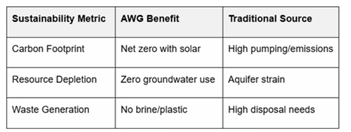
AWGs cut plastic by 90% vs. bottles, with low-impact ops. Paired with solar, net zero emissions rival nature’s water cycle.
Economic & Policy Recommendations
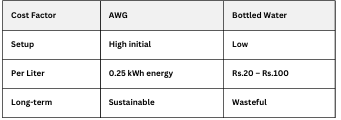
Cost Analysis
- Operational: Rs. 1.6/liter vs. bottled Rs.20 – Rs.100
- ROI: 2-4 years in high-use scenarios.
From Technology to Humanity
Water is not just a resource—it is a human right. When access to clean water becomes uncertain, it affects:
- Health
- Education
- Productivity
- Gender equality
- Social stability
By decentralizing water production, AWGs democratize access. They reduce conflict over shared resources and empower communities to become self-reliant. The shift from centralized supply to localized generation mirrors what solar energy did to electricity. Once unimaginable, now indispensable.
Conclusion: Engineering Hope from Air
Humanity has always thrived by learning to work with nature rather than against it. Atmospheric Water Generators embody this philosophy—harvesting what already exists around us, without depletion or destruction. In a world where water insecurity threatens progress, AWGs offer a powerful message: solutions are all around us—sometimes even in the air we breathe. From humidity to humanity, atmospheric water generation is not just a technological innovation—it is a promise of dignity, resilience & sustainable coexistence for generations to come.